
Judges 17
On money, parents, and filling empty hands
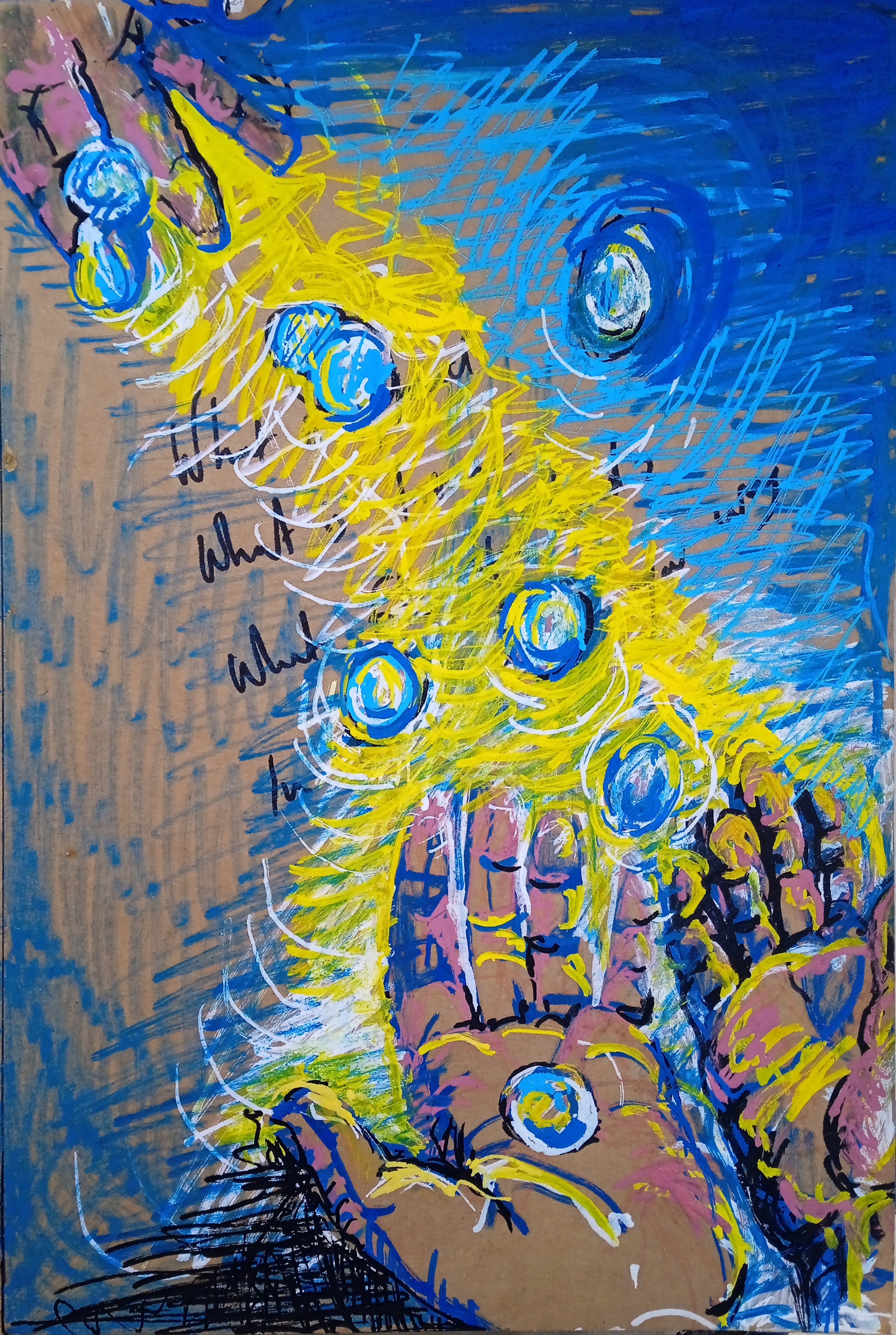
What is taken
what is offered
and what fills your gaping hands
along your way
To read the full chapter, click here
This next chapter begins abruptly, with no mention of the passage of time (the usual bridge between sagas), nor any reference to an external oppressor. We have left the realm of history, to enter the timeless space of the domestic: a "man from the mountains of Ephraim" in the middle of an exchange with his mother about money.
Yet despite the change of ambiance and setting, there is a strange yet clear textual link to the Samson story: the precise sum of 1100 silver coins--paid by the Philistines to Delilah for Samson's secret--repeated here, twice, as the sum stolen by Micah from his mother. More subtle: this timeless "in those days" is defined by "each man did what was right in his own eyes" (yashar b'enav), an echo of Samson's justification for his choice of Philistine wife: "for she is right in my eyes" (yeshara hi be'eynai).
The linkage between Micah's coins and Delilah's blood money places money at the center, while embuing it with dark associations of betrayal and possession. And indeed, the relationship between Micah and his mother zings around these coins, which change hands repeatedly between them: Micah steals from his mother who curses him, then retracts the curse; He says he will return the money; she gives the money to him; then retracts this offer as he returns her money. Instead, she gives him a fraction of the sum to pay for "an idol and an ephod"--returning us to the Gideon story, with its possibility of hereditary kingship, at a time "when there is no King in Israel.".
The intense interaction of mother and son contrasts with the Samson saga, where Manoach keeps asserting his own centrality. The backdrop is haunted by the gaping absence of the father. And indeed, in the next subsection, the father moves center stage: Micah is revealed to be a father himself, as he "fills the hands of his son" to make him the priest of this new house of God-idolatry. Yet when a young Levite passes by, Micah sees an opportunity. Even as the Levite emphasized his migratory status as one who is opportunistically looking to "sojourn where he finds," Micah eagerly grasps at him, begging him to "stay with me and be my father and my priest," the missing father found at last.
To offset this desperation for relationship, Micah offers money: " I will pay you ten shekels of silver a year." The Levite accepts the blandishments he "has found", and has "his hands filled" in place of Micah's son. Though Micah searched for a father, "the youth became like one of his own sons" and Micah is convinced that this fraught father-son triangle has somehow earned him God's blessing.