
Judges: Chapter 13
Annunciations of hope and dread
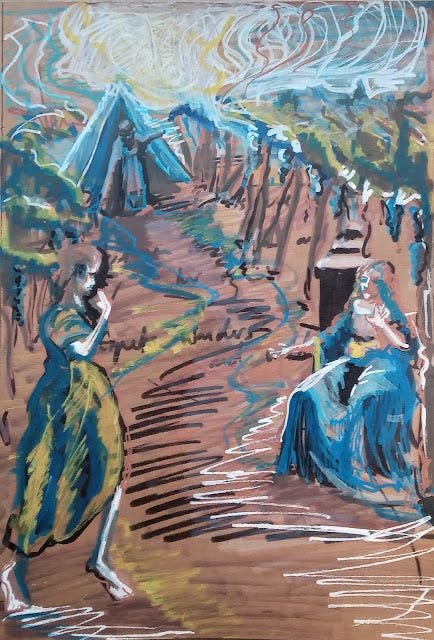
The nameless space
between a woman and her man
expect wonders and the wild
[For full chapter, click here
After a spate of minor, short-term judges, we arrive at another definitive period of 40 years—this time of oppression rather than leadership. This definitive break indeed sets the stage anew. What follows is a story about a woman who "is barren and has born no children," taking us back to the nation's prehistory, to the barren matriarchs Sarah, Rebecca and Rachel.
Once again, we have a scene of annunciation, with a mysterious figure hovering between angel and man, announcing the birth of a longed-for child. Yet if Sarah overheard the message spoken to Abraham from "within the tent," this time the message is given directly to "the woman" as she sits in the open field. The chapter revolves around and accentuates this tension. Manoach expects the message to be given to him; "prays" (va'yetar, in an echo of Isaac's prayer for a child in Genesis 25) for the message to be given to him; and yet the "man" of God appears once more to "the woman". Monoach receives the message only because "the woman" runs to call "her man", and the angel repeats his instructions.
The woman is a nameless "wife of," yet even as Manoach tries to override her role as intermediary, only she can receive this message of hope and warning. Indeed, her namelessness aligns her with the angel, who "gave no name" and warns Manoach not to ask for one (in another primordial echo, this time of Jacob's battle with the angel at Penuel).
The message consecrates the to-be-born child prior to birth, dedicating the woman's body. He is to be a Nazarite "from the womb until the day of his death," ringing a toll of doom, with death present before the child is even conceived. He is only to "begin to redeem Israel from the Philistenes,"but will not be able to complete the job. The abstention from wine and the wild hair are double edged, for in limiting the body, they make the body more present. This child is to be very corporeal. God "pulses" within him, squeezing him like a heart.
"My name is wonderous" (pilli פלאי), says the angel in response to Manoach's request for a name. The root p'l'e returns us to the original definition of the Nazarite as someone who "goes beyond" (yafil יפלאי), his very abstention a borderline transgression, requiring a sin-offering. This child-to-be-born will be a wildcard--wonderous, transgressive, and doomed.
The laws of the Nazarite appear immediately after those of the Sotah, the wayward wife, and the two sections are full of intertextual allusions, the Sotah's wild locks (p'r'e) a precursor of the Nazarite's wild mane (p'r'e). The two are presented as inverted transgressions, mirror images of how we deal with the issues of boundaries and bodies.
Within this context, the focus on Manoah's "woman" and "her man" (the two leitwords of this section) takes on primordial force. We are entering a story that returns us to the primal relationship between ish and Isha, defined all the way back in the Garden of Eden. The angel, defined by Manoach as "the man who spoke to the woman" becomes borderline transgressive, creating a proto-Sotah triangle, except that in this case, the "man" does not become jealous. There is trust to counter the dangers of intimacy.]