
Judges: Chapter 19
On widening circles of dissolution and betrayal, and the return of Sodom
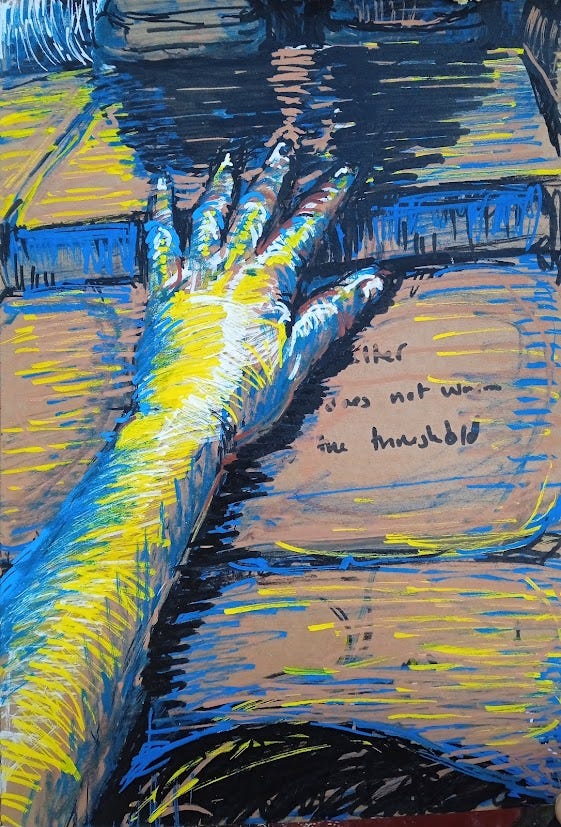
Delay the departure, the return
there are shelters with no safety
fellowship that does not warm
paths that go nowhere.
Cling to the threshold.
For full chapter, click here
This chapter shares a chronotope with the preceding chapter: it too takes place in the timeless "in those days"; it too refers to the twin spaces of Beit Lehem of Judah and the Mountain of Ephraim. It is further linked by various intertextual elements: the centrality of the father, the unusual term for "be persuaded"--ויאל vayoel-- and repeated references to a youth, near, and to a Levite.
This final section of the Book of Judges, characterized and linked by the the repeating refrain "in those days there was no king in Israel", tells a story of ever-widening dissolution. It begins with the domestic, with Micah's betrayal of his mother; and extends to the tribal, with the Dannite abandonment of their territory and the House of God; here the breakdown spreads to the national, as the Levite calls together the 12 tribes of Israel. The widening canvas is accompanied by the stripping of individuality: in the story of Micah, the protagonist is named immediately; in the story of the Dannites, the Levite's name is revealed only at the very end; in this story we are left with nameless archetypes: a Levite, a girl, her father, an old man.
Indeed, as the story opens with a nameless Levite from Mount Ephraim, he can be confused with the Levite priest of the Micah saga. Yet if Micah's Levite is identified as a youth (naar נער), with a hint of innocence to offset his opportunism, the nameless "Levite" of this story is defined as a "man", with the appellation naar split and applies to other characters--to his servant-boy (naar), and his youthful concubine (referred to as naara). Innocence is transferred elsewhere, leaving only ruthless faithlessness.
And if the story of the Danites gestures towards the future, to the "exile of the land", this story returns us to the nation's prehistory, to the story of Sodom and its destruction). Abraham's future nationtionhood is reified in the same scene that declares the judgment of Sodom--a primary bifurcation. Yet here Israel has created its very own version of the evil city in Gevah.
This version of Sodom is both more local and more crude than the original. If in the original story, we have a mythic morality tale of "the entire city" rushing to attack the righteous Lot and his angelic guests, here a local "group of louts" surrounds the house of the old Ephramite host and his all-too-mortal guests. The attackers are fewer, and not as violent--only "pounding on the door" rather than seeking to "break" it; yet those being attached are far quicker to surrender the weakest amongst them. Lot offered his "two virgin daughters" to the marauding mob "to do with them as was good in their eyes." Here, the old man offers his daughter and the Levite's young concubine to explicitly "rape", only then returning to the euphemism of "what is good in your eyes." And if in the original story, the horrific offer never comes to fruition, as the angels guard the limen with blinding light, here the Levite brutally and heartlessly shoves his young concubine “outside,” himself breaching the guarded threshold.
The association of a "girl" (naara) and "outside" is dire. When the girl Dinah "goes out", she is raped by Shechem, And indeed, the dark future of the concubine is foreshadowed right at the opening of the story, when the Levite goes to "speak to [her] heart," echoing Shechem's attempt to appease Dina after raping her by "speaking to the heart of the girl (naara)." The Levite "master" is presented as aligned with the raping mob.
The threshold between inside and out, the space of feminine power in the Deborah saga, here becomes the site of female vulnerability. The concubine, excluded from the syntactic fellowship of plural verbs (they ate and drank ) which include only the men (the two of them), is now shoved out of the literal shared space, the door slammed behind her. After surviving a night-long gang rape—her own version of Jacob’s battle till “the breaking of the day”—she collapses with hand outstretched on the limen, futilely begging protection.
The gesture remains unanswered. When her indifferent "master" finds her in the morning, he finishes the work of dissolution, carving her violated body into literal pieces. Denied outer shelter, the interiority of the girl's body was repeatedly breached, and now he violently enacts the breaches in her outer form, destroying her completely.