
Judges: Chapter 21
on national birth and blindness, and the choking vise of vows
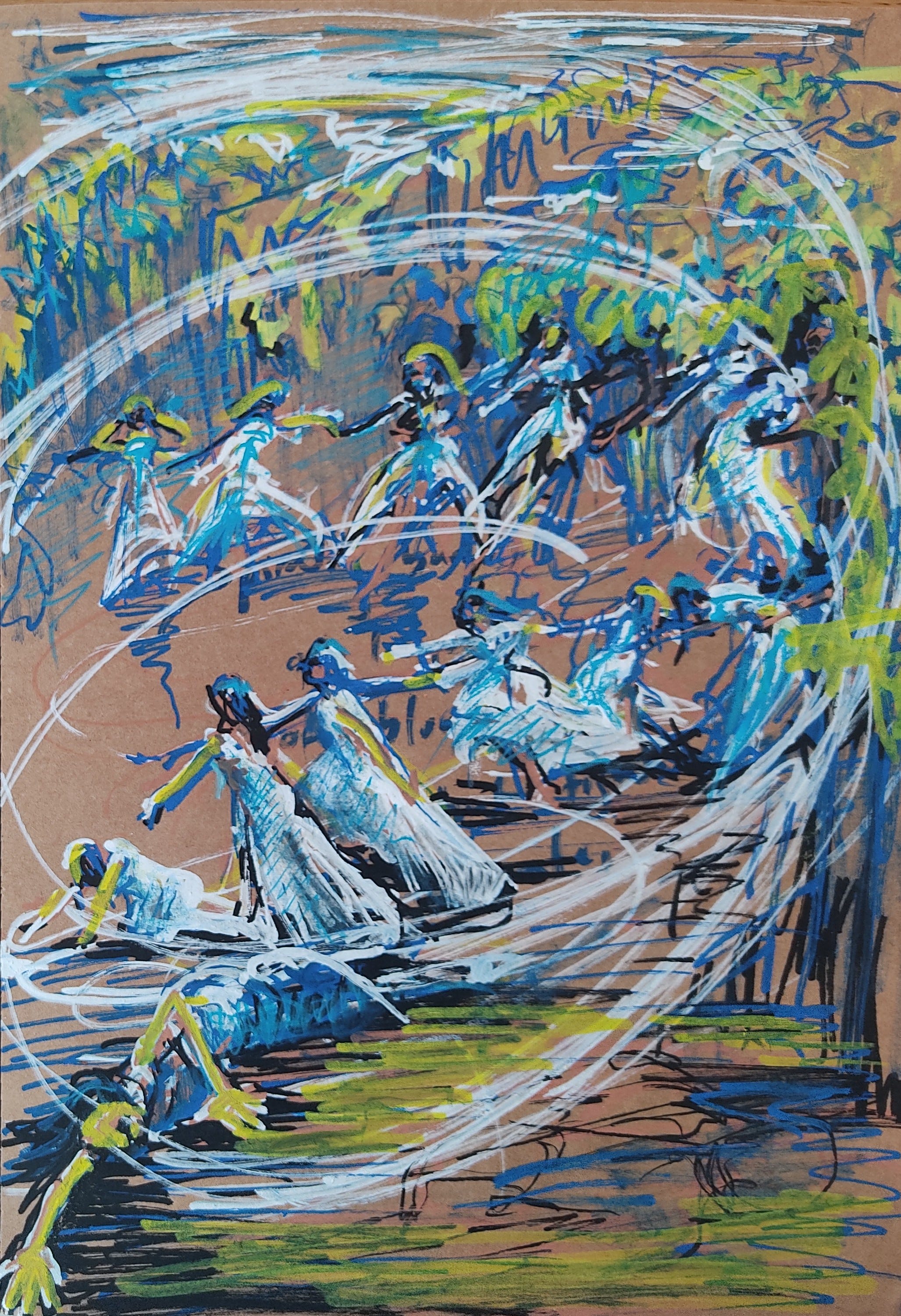
Bound in widening spirals
of language and blood--
that close like a vise
then dissipate.
For full chapter, click here
The war is over. And with the decisive victory, the self-righteous bloodlust of battle withdraws, to leave Israel to face what they have wrought: a tribe decimated, with only a handful of survivors left hiding in the desert. The escapees have been picked off along the way, all women and children slaughtered.
The utter destruction triggers consternation—but no self-awareness. Israel weeps, but does not confess. Instead they helplessly ask Oh God of Israel, why has this happened in Israel, that one tribe must now be lost from Israel? Their own actions are seen as an external force, something that "happened."
This childish cry has a dual face. Embedded within it is a new development. For the first time, the nation sees itself as an entity. They are “Israel” (repeated three times) rather than an amalgamation of tribes. And the loss of a tribe–even an enemy tribe–will irrevocably damage this new entity.
Yet this emergent national awareness comes within a troublesome context, as helpless weeping has a dire history. The people wept in the desert all night after the Spies' report–and lost their tights to the land. At the opening of this book, the people weep again at the angel’s rebuke—and instigate an iterative cycle of breakdown. National weeping marks an abdication of responsibility, self-indulgent self pity. Now the people weep a "great weeping,"—and seek a solution that does not reflect on their own culpability.
On the contrary–they solve the problem of the decimation of Benjamin with the same authoritative murderousness with which they decimated Benjamin. Gebah was condemned, no questions asked. Then the whole tribe of Benjamin was slaughtered. Now, Yabesh Gilead is also to be put to the sword--except that in this case, the virgins will be preserved (the term hay in an eerie echo of Pharoh’s exemption of the females from his genocidal decree to kill the baby boys), in order to provide wives for the Benjaminite survivors. For the people, united in their single voice, had sworn not to “give their daughters to Benjamin”.Having killed all the Benjaminite women, they have condemned the tribe to oblivion. The preserved women of Yabesh Gilead provide an escape route.
The intertextual links with the Jephthah saga are striking–and illuminating. Jephthah of Gilead was the first to break the taboo on internecine warfare, when—instead of dissipating the tribal tensions that permeate the book— he slaughtered Ephraim. Perhaps it was this direct brush with civil warfare that makes the people of Jabesh Gilead wary about joining the anti-Benjamin alliance.
Jephthah is not only the instigator of civil wars, he is also the speaker of dangerous vows. The parallels between Jephthah's and Israel's vows are many. In both cases, the vow revolves around daughters, and their ability to marry. In both, the vows create bareness, cutting off the future. Jephtha condemns his "only issue", axing his family line; here, the vow cuts off the tribe of Benjamin. Yet in both cases, the speakers refuse to take responsibility for their speech act, seeing themselves as victims of an external force.
And in both cases, the aftereffects are tragic, particularly for women,. Jephthah's treatment of his daughter initiates mass female mourning, as the women head out to the hills miyamim yemima (“yearly”)to commemorate her loss. Here, Israel's solution to the vow ostracizing Benjamin is to provide captive brides. The nation lean on another “great vow” to offset their first vow: in addition to cutting off Benjamin, the people had also vowed to execute all those who did not join the national assembly. Under this pretext, they annihilate the city of Jabesh Gilead, preserving the captive virgins as wives to the Benjemenite survivors. When these are insufficient, the men of Benjamin are instructed to lay in wait (the word “ambush” arev is particularly resonant, as it was an ambush that destroyed the tribe), and kidnap the girls who go out dancing in the vineyards, miyamim yemima.
This serves as a reminder that vows, from their very introduction, are inexplicably related to issues of gender: a man’s authority over a woman is expressed in his ability to undo her vows, to control her speech. Within history, vows are used more directly and explicitly to control women’s physical being: blocking marriage, controlling fertility, and here, triggering kidnapping and forced marriage.The dances (meholot) that during the Exodus expressed Miriam’s redemptive power are subverted. Jephtha’s daughter is undone by her dance towards her father; the dancing here renders the women vulnerable.
It is telling that the battle that supposedly began over a brutal gang rape ends in sanctioned abduction and rape. The objectification of the concubine with her penetrable, dissectible body, here moves to the national level, as women become faceless vessels of reproduction. The vows grant a vise-like control over words and narrative, preventing all questions and change. A key divergence from the Jephthah saga is illuminating: Jephthah makes a neder–a vow that sanctifies something to God; his commitment to the “utterance of his mouth” is part of a lifelong quest to infuse human language with God-like accountability by bringing all questions to this ultimate Other. The Israelites, by contrast, make a shevuah–a vow that focuses on the human relationship to objects. The consequence of breaking this vow are not God's wrath, but a human curse: “yet we cannot give them any of our daughters as wives,” since the Israelites had taken an oath: “Cursed be anyone who gives a wife to Benjamin!” (21: 18). The newly self-consiouce Israel are caught in a language loop where their vows are reinforced by their own imprecations, each amplifying the other.
Something new is indeed born in this final section of the Book of Judges, bookended by its repeated refrain: In those days there was no king in Israel. A unified national identity is coming into being. Yet it is a monolith identity, that speaks as “one man” and squashes all dissent with death. Its assertion of authority is lumbering, dangerous, and blind, calling to mind's Yeat's haunting description of a time when "The best lack all conviction, while the worst / Are full of passionate intensity." Indeed, "what rough beast, its hour come round at last / slouches towards Bethelehim to be born?"