
Samuel: Chapter 2
On tansformation and flux
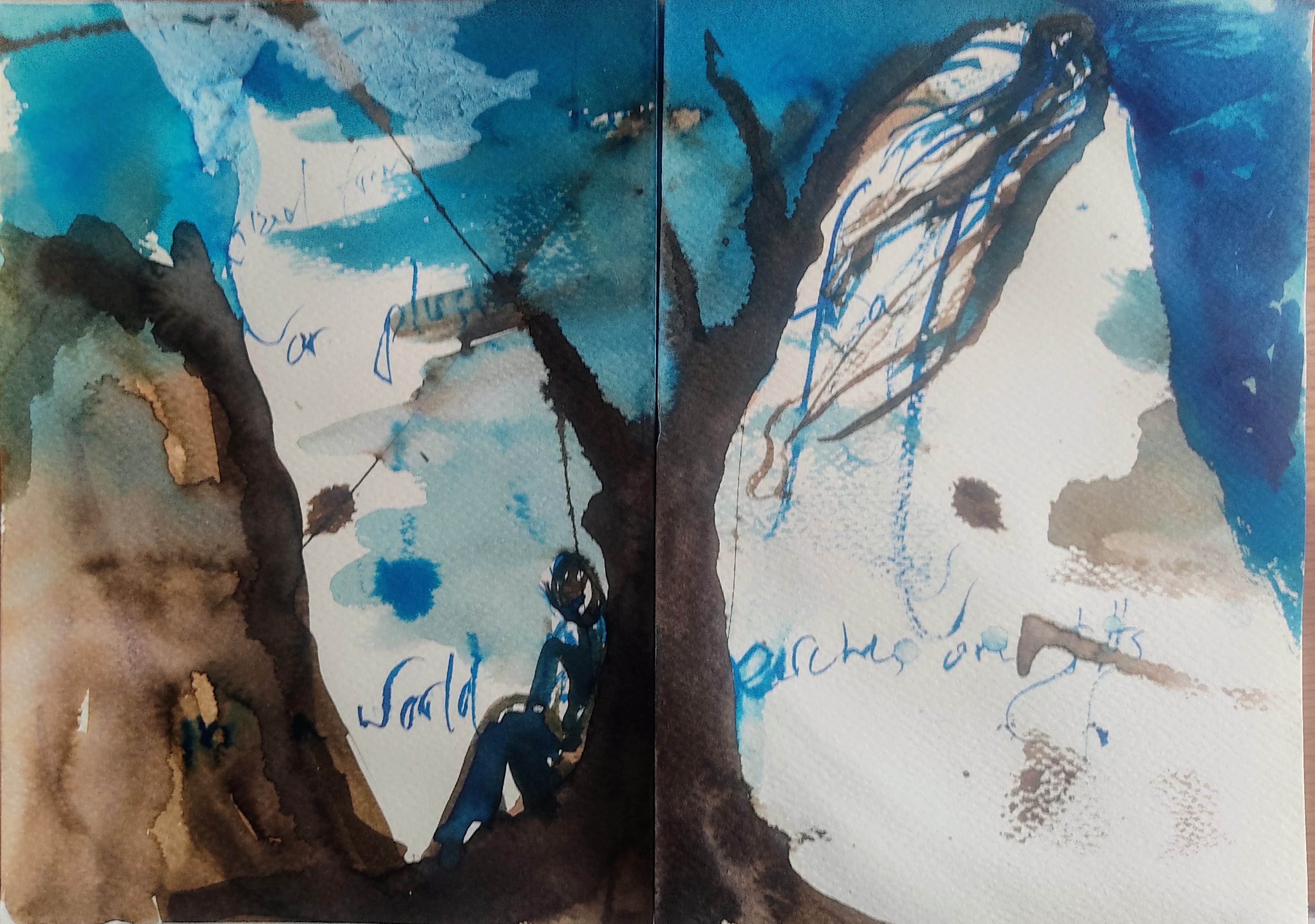
You can be raised from the depths
or plunge in free fall
in a world that perches on stilts
For full chapter, click here
It has been a long break, in which a lifetime has passed. First I completed the drawing but delayed photographing it because the notebook started to fall apart. Then the war started. Between bomb-shelter runs, a broken notebook seemed less important, and I decided to post it, but forgot to put it on Substack. Now, I am refinding my bearings post-apocalypse, and am trying to get back on track. Again.
Crisis. Restart. Crisis. Restart. This has become the pulse underlying Bibliodraw, and is perhaps appropriate for this chapter of mutability--a world in which all is conditional, and can be flipped in a moment.
The chapter opens by returning to, and emphasizing, Chana's radical redefinition of prayer.: And Chana prayed , once again using the new reflexive va-titpalal (ותתפלל). She even draws attention to her new conception, demanding, in a double wordplay: If someone sins against another person, God may intercede ((p'l'l פלל, lit. "arbitrate" "judge" ); but if someone offends against God, who can intercede (יתפלל) ?” Prayer is now intimate intercession,an interactive, reflexive, act of connecting heart and mouth, inside to outside. "My heart exhalts...my mouth opens wide". Hanna, through prayer, links to the intimacy of the "God of knowings" (el deot), who knows multiple minds, but is also multitudinous.
Indeed, this is the essence of her thanksigving prayer: God is the anchor around which "all acts are measured", yet he teems with otherness, so that the world is inherently unsteady, in flux. Everything can transform into its opposite, as God contains both sides of the binary: the satiated may become hungry, the barren full, life and death, the netherworld and the exalted skies, poor and noble, the humiliated and the proud —all can morph into each other.
The chapter then proceeds to demonstrate this thesis, as Eli is given a prophecy about the coming fall of his dynasty: "I had intended for you and your father’s house to remain in My service forever. But now—declares God—far be it from Me!" Even the priesthood that was granted to Aaron as a gift that could not be questioned is not immutable. The foundational structures of the nation rest only on the relationship with God. The "enduring house" will be reserved for a new, "faithful" priest.
It is within this fraught context that the idea of kingship is introduced. In a final departure from Judge's, era "when there was no king in Israel, each did what was right in his own eyes" Hanna concludes her exhaltant prayer with the call: "God will judge the ends of the earth— / Giving power to the king, / And triumph to the anointed one.". This call forshadows a new political era. Yet it also intimates that the king will not be the stabilizing force foreseen by Moses. Rather, he will be part of the world of flux and revsersals, where even the greatest of gifts can be taken away by a God that judges the very "ends of the earth" allowing them to transform --ouroborous like-- into each other.