
Samuel: Chapter 11
On redemptive retellings
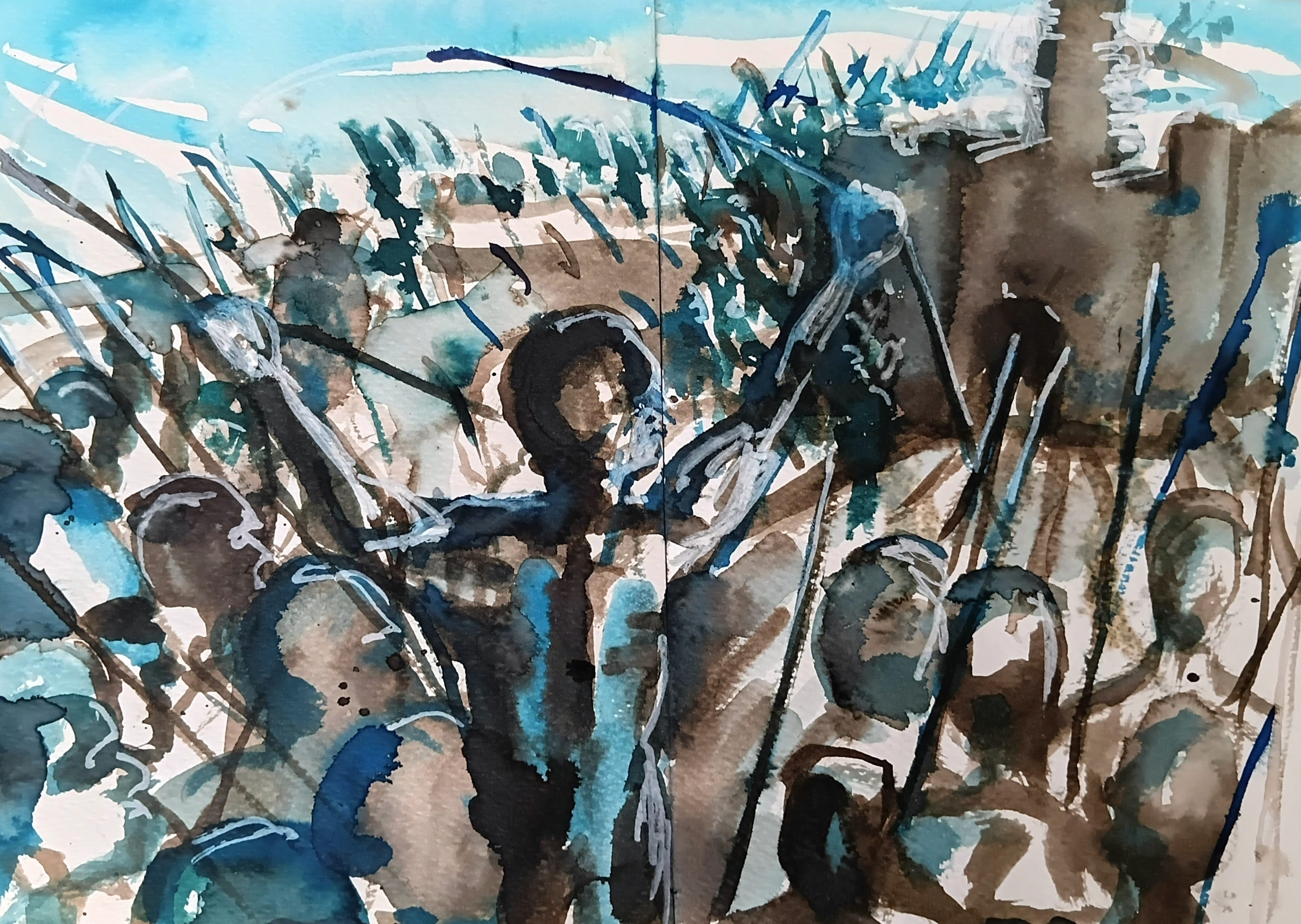
Push the bounds
to find the story.
and tell it anew
For full chapter, click here
This chapter continues and intensifies the Book of Samuel’s redemptive dialogue with the closing of the Book of Judges.

If Samuel’s opening chapters revisit the relationship to women and to vows, here we return to the painful linchpin of Judges: the relationship of the individual to the tribe and national framework. These issues came to a head in Judge’s final stories of Samson and of Geva. The saga of Samson embodies the extreme of individuality, the story of Geva exemplifies its opposite: nameless characters acting within a context of mob rule.
Samson is consecrated before birth, pulsing with the presence of God, never “like one of the people.” In his superhuman strength, he is the archetypal superhero, and his fight with the Philistines is that of a lone vigilante. He is a leader who dies, as he lived, separate from his people. It is only after death that he can be brought back “to his fathers.”
On the other side of the spectrum is the Israelite response to the incident at Geva, in which “all Israel, brothers” unite to fight Benjamin.

This is a model of national identity sans individuality, where the people seem to spontaneously self-organise into cohesive national identity without any one leader. Yet it is an identity that demands conformity, ruthlessly destroying dissent.
Both these stories are framed by the shared refrain: “In those days there was no king in Israel.”
This chapter returns to these painful sagas, reframing them in the context of “a king in Israel.”
Here, the tragedy of Geva runs in reverse, as though time can be turned back and redeemed. The allusions to Geva introduced in the previous chapters become more explicit and insistent. Now it is Yabesh Gilead, destroyed in the aftermath of the war on Benjamin, that is attacked. As in the case of the concubine, there is a threat of mutilation. The people of Yabesh, like the Levite in Geva, send messengers to “all the borders of Israel”--this time a call for help rather than revenge. As in the case of Geva, the people respond with helpless weeping.
Ironically, help comes when the message reaches Geva itself. This time it is Saul who acts the part of the Levite, tearing apart flesh--of animals, rather than a woman. Like the Levite, he sends these body parts to “the borders of Israel” to call in the people to war. This time, the message is not of mute visceral horror, but an explicit command. And the people come, “as one.”
In this iteration, the rejected tribe of Benjamin comes to the rescue of the city it indirectly destroyed, rewarding Yabesh’s previous hesitancy about joining the civil war. This time, as Saul takes responsibility, the weeping is turned to “joy” (a leitword repeated several times at the closing of this chapter).
Saul’s leadership ties the story of Samson into the iteration of Geva. When “the spirit of God descends upon him,” Saul not only acts the part of the Levite, but also channels Samson’s preternatural power in tearing apart the lion. Nahash’s threat to poke out the people of Yabesh’s right eye also evokes Samson, echoing his prayer to be “avenged of one of his eyes.” Samuel-- a Nazarite consecrated before birth--begins the rehabilitation of Samson by placing this vast concecrated power within the confines of the Mishkan. Saul now also channels the inspired, charismatic leader, placing his power in a national context: in this iteration, the cleaving of an animal is used to call the nation together rather than as a personal symbol.
Saul’s first battle as king weaves together the two sides of Judges’ pendulum, placing the individual within the national structure, while installing a leader at the head of the faceless masses, thus mitigating their potential forviolence.
Yet Saul does play this part alone. There is a consistent pattern of triangulation--between Saul, Samuel and God; and between Saul, Samuel and the people. The people follow “after Saul... and after Samuel... and fear God.” The merging of Saul and Samuel continues , as Samuel the prophet enables linkage and communication.